
















West Bengal’s current turnout is, by most credible estimates, the highest in its history (at least since Independence) and among the highest recorded anywhere in India. Tamil Nadu, too, is witnessing unusually strong voter participation, suggesting a broader pattern of heightened electoral engagement across key states.
What this surge signifies, however, is far from straightforward. High turnout does not automatically translate into an advantage for any one party. It can reflect anti-incumbency sentiment, but it can just as easily signal countermobilization, where sections of the electorate, including minorities and politically energized groups, turn out in greater numbers in response to perceived threats or polarizing narratives. In that sense, the increased participation could be read either way: as a desire for change or as a defensive consolidation against policies and rhetoric associated with the ruling establishment. The true direction of this electoral energy will only become clear when the results are declared.
At the same time, the process itself is under sharper scrutiny than ever. Concerns about the Election Commission of India's functioning have become more pronounced, with critics arguing that its actions increasingly appear aligned with the interests of the ruling Bharatiya Janata Party government led by Narendra Modi. Allegations of uneven enforcement of the Model Code of Conduct, where opposition leaders face swift censure while similar or more serious violations by those in power draw muted responses, have fueled a perception of institutional bias.
Equally troubling for many observers is the gradual erosion of democratic norms. India has long taken pride in the credibility and independence of its electoral processes, but that confidence now appears to be under strain. The tone of political discourse has grown sharper, enforcement is increasingly seen as selective by critics, and the line between state machinery and party interests has become progressively blurred. The recently concluded SIR has only added to the uncertainty and confusion.
Ultimately, while the numbers point to a vibrant and engaged electorate, the deeper question is about the quality of that democracy, not just how many people vote, but whether the system inspires equal trust across the political spectrum. The final verdict will emerge with the results, but the broader debate about institutions and democratic resilience is likely to continue well beyond them.
Until recently, Kerala had largely remained insulated from the kind of allegations, whether around EVM integrity or procedural lapses, that have surfaced in other parts of the country. That perception of relative immunity now appears to be under strain. Even if these concerns are not universally accepted or proven, their very emergence signals a shift in public discourse around electoral transparency. In a state with high political awareness, any hint of a lack of openness can quickly become a matter of serious debate.
At the same time, the UDF's confidence in its electoral prospects may lead it to underestimate these underlying anxieties. Electoral outcomes are shaped not only by voter preference but also by trust in the process itself. Increasingly, critics have questioned whether institutions such as the Election Commission of India are maintaining the same level of perceived neutrality, a concern that has been voiced across sections of the opposition.
The rhetoric from the Bharatiya Janata Party leadership has also added a new dimension to the political conversation. During campaign speeches in Kerala, Narendra Modi declared that the BJP could emerge as a decisive factor in government formation. At first glance, this may seem aspirational given the state’s entrenched bipolar contest between UDF and LDF. However, a closer look at recent electoral data suggests that such a scenario, while still unlikely, is no longer entirely implausible.
In the 2024 Lok Sabha elections, the BJP led in 11 Assembly segments and finished second in 6 more. In several of these constituencies, the margins were narrow, sometimes just a few thousand votes, and in certain cases even under a thousand. This indicates that while the BJP lacks a broad statewide base, it builds pockets of competitiveness that could become significant under the right circumstances.
If one were to imagine a tightly contested Assembly election, say, a scenario where UDF and LDF each secure around 65 seats, and the emergence of BJP with even a small bloc of MLAs could fundamentally alter Kerala’s political dynamics. A hung assembly, long considered improbable in the state, would usher in a new era of coalition bargaining in which the BJP, despite its limited base, could wield disproportionate influence. While this remains speculative, it is no longer outside the realm of possibility given the gradual expansion of the BJP’s social and electoral outreach, particularly among segments of OBC, SC/ST communities, and sections of the Christian population willing to experiment politically.
However, this outreach has also encountered setbacks. The controversy surrounding a reported draft amendment to the Foreign Contribution Regulation Act (FCRA) has become a point of political vulnerability. The perception, especially among Christian institutions, that such provisions could enable increased scrutiny or even seizure of assets has generated unease. For a party that had been attempting to make inroads into sections of the Christian community, particularly by leveraging identity-based narratives, this development appears to have complicated its strategy. Whether this episode was the result of a deliberate political signal or an unintended leak remains unclear, but its political impact is evident in the heightened apprehension it has triggered.
In sum, Kerala’s electoral landscape is entering a more complex phase. The state’s traditional bipolarity is still intact, but subtle shifts in voter behavior, institutional trust, and political messaging are introducing new variables. Whether these changes culminate in a structural realignment or remain incremental will depend on how both voters and institutions respond in the coming electoral cycles.
Finally, the credibility of Indian democracy rests heavily on the trustworthiness of its electoral process, including the voting infrastructure. Allegations of EVM tampering, if ever conclusively established, would indeed strike at the very foundation of that trust. At the same time, it’s important to distinguish between allegations, technical possibilities, and verified evidence, because the strength of a democracy depends not only on vigilance but also on rigor and proof.
Concerns about EVMs in India are not new. The Election Commission of India has consistently maintained that Indian EVMs are standalone, non-networked devices, designed specifically to prevent remote hacking. That said, critics, including opposition leaders such as Rahul Gandhi, have raised broader concerns about the integrity, transparency, and auditability of the electoral roll. Issues like duplicate or “dummy” entries in voter rolls have been flagged in the past. Opposition parties argue that the process lacks sufficient transparency and independent verification.
On the technical side, claims about vulnerabilities, such as the possibility of firmware manipulation or hardware-level compromise, are often discussed in theoretical or academic contexts. Critics argue that without independent, data-driven forensic audits, the system cannot fully command public confidence. It is also true that India’s audit framework differs from that of some other democracies. While VVPAT exists, India does not conduct full-scale risk-limiting audits or universal paper trail verification after every election. Expanding such mechanisms could help strengthen trust, regardless of whether vulnerabilities exist.
In the end, the resilience of Indian democracy will not be judged merely by voter turnout or electoral outcomes, but by the credibility, transparency, and fairness of the process itself. As participation reaches record levels and political competition intensifies, the burden on institutions like the Election Commission of India to remain impartial and inspire public confidence becomes even greater. Allegations about voting systems, electoral rolls, or enforcement must be addressed through credible, data-driven, and independently verifiable mechanisms, not dismissed or politicized. A democracy as vast and diverse as India cannot afford even the perception of bias or lack of openness. Ultimately, safeguarding the integrity of elections is not the responsibility of any one party or institution but it is a collective obligation, essential to preserving the legitimacy of the republic itself, a lesson so far ignored by those entrenched in power.
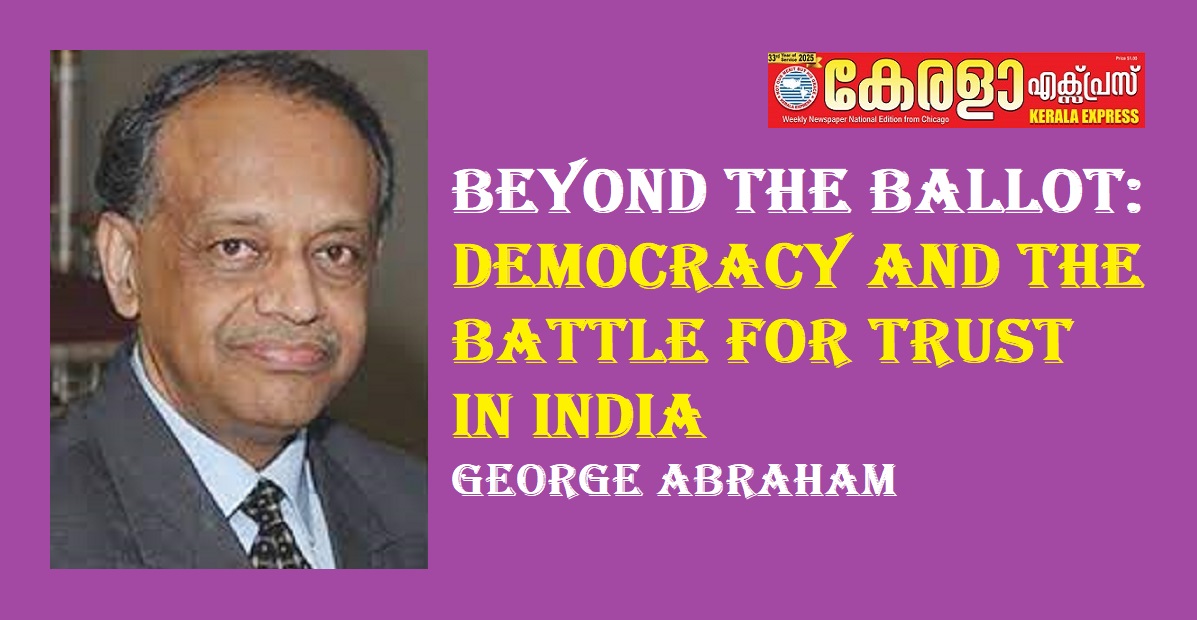
George Abraham