
















“Being an Indian housewife means having eyes in the back of your head, a superpower to find anything in 5 seconds flat, and a PhD in silent judging."- seems to be a sarcastic statement, that is changing now!
The Supreme Court of India has delivered a verdict that goes far beyond the question of compensation in a motor accident case. In one of the most socially significant judgments in recent years, the Court has declared that unpaid domestic work performed by women must be monetised at a minimum value of ₹30,000 per month and, more importantly, has recognised homemakers as “nation builders.”
For generations, Indian society has taken household labour for granted. Cooking, cleaning, raising children, caring for the elderly, managing family finances, and providing emotional support have often been viewed as duties rather than work. Because these tasks do not generate a salary, they have frequently been dismissed as having little or no economic value. The Supreme Court has now challenged this deeply entrenched misconception.
The case arose from a tragic road accident in Punjab in 2001, where a woman lost her life. Her husband and three children sought compensation before the Motor Accident Claims Tribunal. In deciding the appeal, the Supreme Court seized the opportunity to address a larger injustice—the systematic undervaluation of domestic labour.
By fixing a minimum notional income of ₹30,000 per month for unpaid household work, the Court has established a new framework for assessing compensation in cases involving the death or disability of a housewife. Equally significant is the Court’s recognition that the expression “homemaker” itself should not diminish the immense contribution women make to families and society.
The judgment is historic because it affirms a truth long acknowledged by economists and social reformers: unpaid domestic work sustains the nation. Without the invisible labour performed inside millions of homes, the visible economy outside would simply collapse. Children who become doctors, engineers, teachers, and public servants are shaped by mothers and caregivers whose sacrifices rarely find a place in economic statistics. In that sense, the Court’s description of homemakers as “nation builders” is neither rhetorical nor symbolic; it is a statement of fact.
The implications of this ruling extend well beyond motor accident claims. It establishes an important precedent for family law, particularly in matters relating to maintenance, alimony, and financial settlements. It strengthens the principle that a woman’s contribution to the family is not inferior to that of a salaried spouse. By assigning a tangible economic value to domestic work, the judgment reinforces the idea that unpaid labour is productive labour.
This verdict is also a major step towards gender justice. For too long, women have borne the burden of unpaid care work without social recognition or financial security. The judiciary has now sent a clear message that dignity cannot be separated from economic value. A society that respects women must recognise not only those who earn wages but also those whose labour sustains homes and nurtures future generations.
However, this judgment should not be viewed as the final destination. Rather, it must become the starting point for a broader national conversation. India needs policies that acknowledge caregiving and domestic work, improve social security for homemakers, and ensure that women who devote their lives to family welfare are not left financially vulnerable.
The Supreme Court has done more than settle a legal dispute. It has corrected a historical wrong. By valuing unpaid domestic work and honouring homemakers as nation builders, the Court has restored dignity to millions of women whose labour has remained invisible for far too long.
In a country where mothers and wives have silently carried the weight of families and communities, this landmark verdict stands as a reminder that work does not become less valuable merely because it is performed with love and without a pay cheque. Recognition delayed is not recognition denied. The Supreme Court has finally given India’s homemakers the respect they have always deserved.
.JPG)
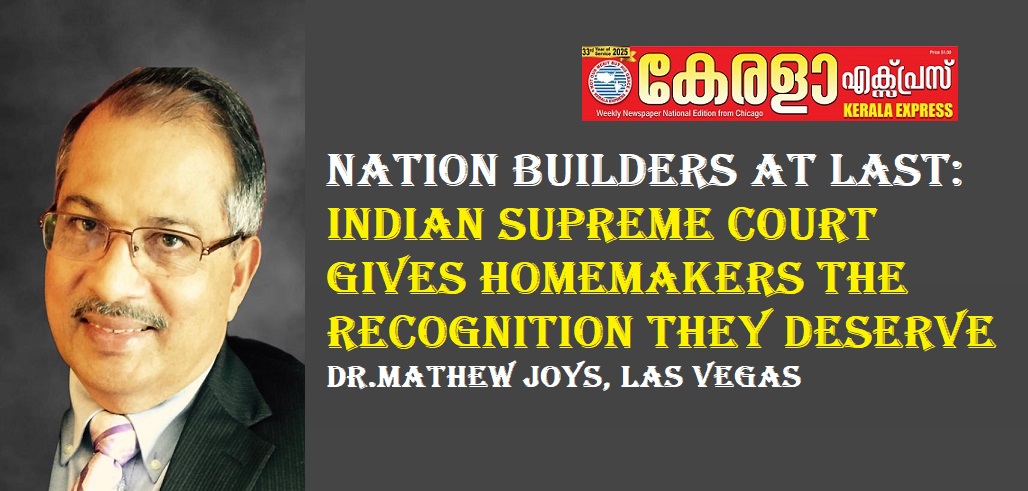
Dr.Mathew Joys, Las Vegas